NAVIGATION
Artificial Intelligence Policy
Ethics and Malpractice Statements


PAPER TEMPLATE

COPYRIGHT FORM





MEMBER OF

SUPPORTED SOCIETIES


SUPPORTED CONFERENCE
VISITORS

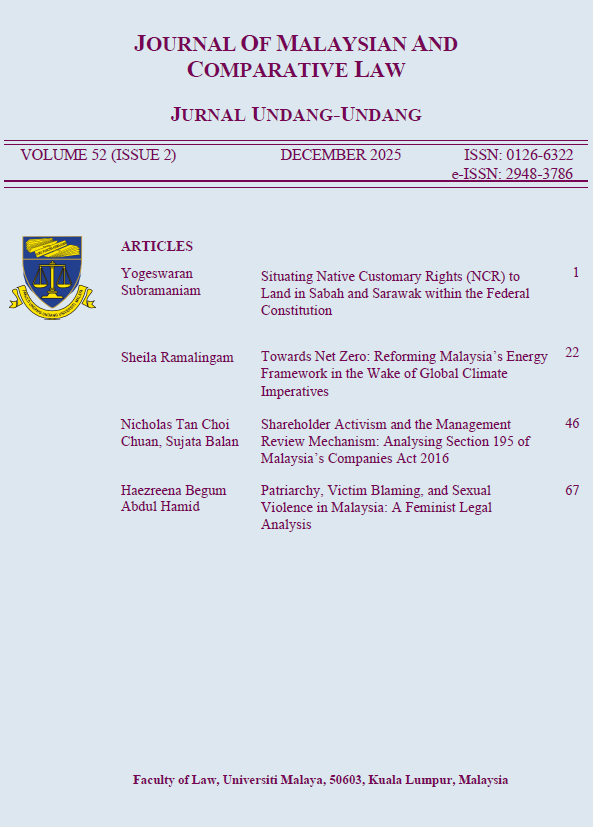
It is our pleasure to present this issue of the Journal of Malaysian and Comparative Law (JMCL), which features four thought-provoking articles that address significant contemporary legal and interdisciplinary issues. Collectively, the contributions reflect the journal's commitment to advancing critical scholarship on constitutional law, environmental governance, corporate regulation, and gender justice. Through doctrinal, comparative, and interdisciplinary analyses, the authors engage with pressing legal challenges confronting Malaysia while offering insights that contribute to broader regional and international discourse.
The first article, "Situating Native Customary Rights (NCR) to Land in Sabah and Sarawak within the Federal Constitution" by Yogeswaran Subramaniam, examines the constitutional recognition and protection of Native Customary Rights (NCR) to land and natural resources in Sabah and Sarawak, where Indigenous peoples constitute the majority population. The article highlights the persistent challenges faced by native communities in securing adequate legal recognition and protection of their customary land rights. It explores the tension between the formal constitutional recognition of NCR and their practical implementation within Malaysia's federal constitutional framework, particularly considering the constitutional safeguards accompanying the formation of the Federation of Malaysia. Beyond constitutional considerations, the author argues that the historical incorporation of English property law concepts into state land legislation has contributed to the legal subordination of native land laws and customs. This argument is further supported by developments such as the 2019 amendment to the Sarawak Land Code 1958, which sought to strengthen the recognition of native customs, and by judicial developments, particularly the Federal Court's decision in the TR Sandah case. The article concludes that, despite the prevailing tendency towards legal centralism, meaningful parity for native land laws and customs remains achievable if State Governments prioritise these matters as a policy imperative.
The second article, "Towards Net Zero: Reforming Malaysia's Energy Framework in the Wake of Global Climate Imperatives" by Sheila Ramalingam, examines Malaysia's transition towards a low-carbon economy within the context of global climate obligations and the evolving national legal and policy framework. The article traces Malaysia's commitments under the Paris Agreement and reviews national energy policies aimed at achieving net-zero emissions by 2050. It assesses the potential contribution of renewable energy sources, including solar, biomass, and hydropower, while critically evaluating the legal and institutional barriers to energy transition, such as fossil fuel subsidies, financing constraints, and governance challenges. Drawing comparative insights from jurisdictions including Germany, Sweden, Finland, and Vietnam, the article demonstrates how policy consistency, carbon pricing mechanisms, and targeted incentives have accelerated renewable energy adoption elsewhere. The analysis argues that Malaysia's energy transition requires stronger governance, innovative financing mechanisms, and inclusive approaches that promote rural electrification and social equity. Ultimately, the author contends that phasing out fossil fuel dependency, strengthening renewable energy legislation, and ensuring meaningful community participation are essential to achieving Malaysia's climate commitments and fostering a resilient, sustainable future.
The third article, "Shareholder Activism and the Management Review Mechanism: Analysing Section 195 of Malaysia's Companies Act 2016" by Nicholas Tan Choi Chuan and Sujata Balan, evaluates the effectiveness of section 195 of the Companies Act 2016 as a mechanism for promoting shareholder activism through management review. Situated within Malaysia's corporate governance framework, the article analyses how section 195 seeks to balance board authority with shareholder participation by enabling shareholders to question, discuss, and make recommendations concerning the management of a company during general meetings. The authors undertake a comparative analysis, particularly with New Zealand's management review framework, to assess the extent to which the provision facilitates meaningful shareholder engagement and corporate accountability. The article concludes that although section 195 has the potential to strengthen shareholder oversight, its practical effectiveness depends upon reforms that enhance its accessibility and operability, particularly for minority and dissenting shareholders.
The final article, "Patriarchy, Victim Blaming, and Sexual Violence in Malaysia: A Feminist Legal Analysis" by Haezreena Begum Abdul Hamid, explores the relationship between patriarchal structures and victim-blaming attitudes in cases of rape and sexual violence. Employing a qualitative discourse analysis through a feminist legal lens, the study examines case law, legislation, academic literature, published reports, and other primary and secondary sources to investigate how women's historical subordination and dependence on men have contributed to the perpetuation of victim blaming. The article demonstrates that patriarchal norms embedded within legal institutions, cultural traditions, religious practices, and broader social structures continue to influence legal and societal responses to sexual violence. Such norms reinforce the scrutiny of women's behaviour and morality while diverting responsibility away from perpetrators, thereby creating significant barriers to justice for survivors. The author argues that patriarchal norms remain a substantial obstacle to achieving fairness and justice in cases of rape and sexual violence and advocates for immediate legal, institutional, and societal reforms that promote gender equality and eliminate victim-blaming attitudes at all levels of society.
Taken together, the articles in this issue underscore the dynamic and evolving nature of legal scholarship in addressing contemporary societal challenges. Whether examining Indigenous land rights, climate governance, corporate accountability, or gender justice, each contribution highlights the importance of law as both a mechanism for regulating society and a vehicle for advancing justice, equality, and sustainable development. We trust that the scholarship presented in this issue will stimulate further academic discussion, inform policy development, and contribute meaningfully to ongoing legal reform in Malaysia and beyond.
Associate Prof. Dr. Mohammad Ershadul Karim
NAVIGATION
Artificial Intelligence Policy
Ethics and Malpractice Statements
MEMBER OF
SUPPORTED SOCIETIES
SUPPORTED CONFERENCE
VISITORS