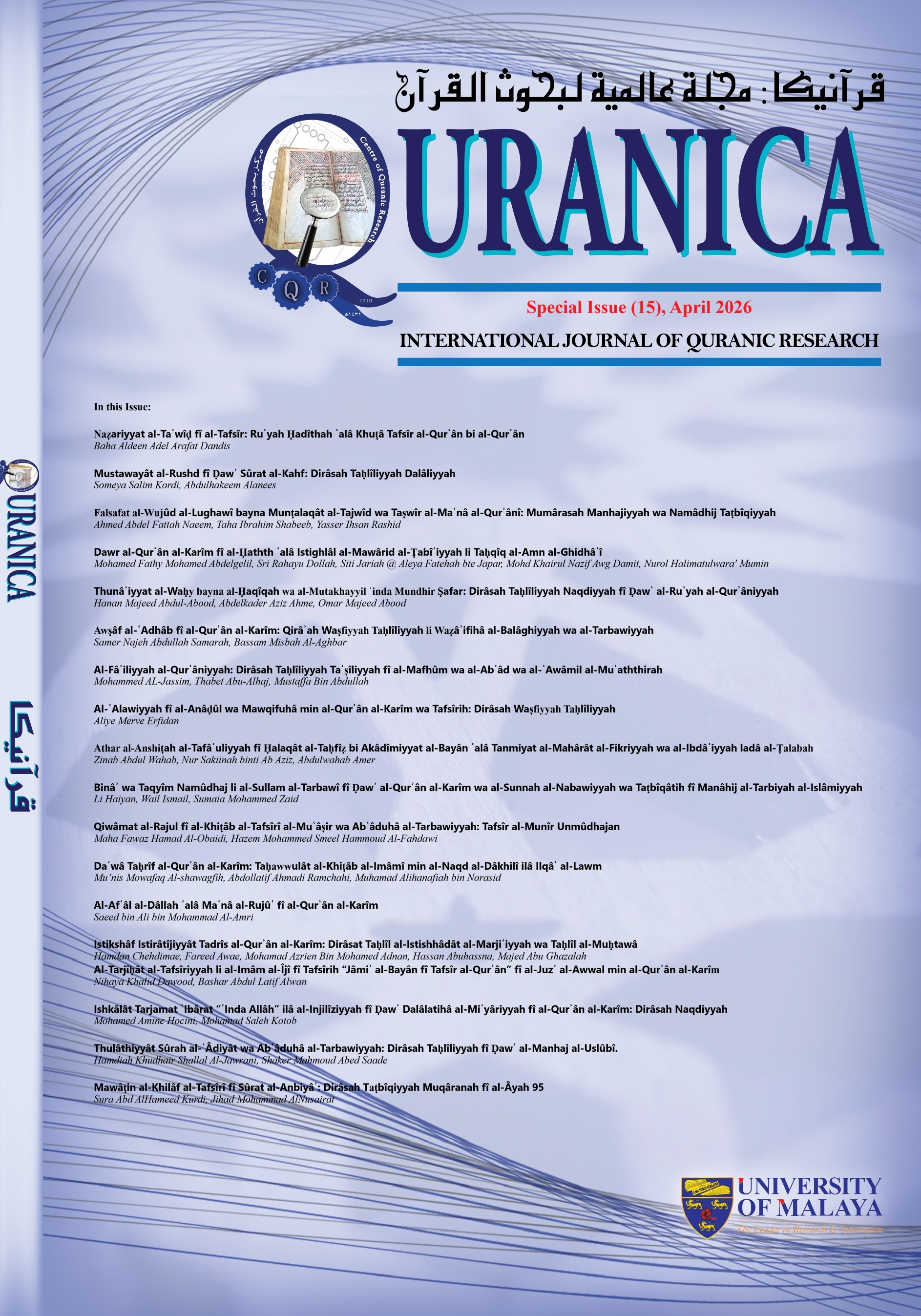
Ishkālāt Tarjamat ʿIbārat “ʿInda Allāh” ilā al-Injilīziyyah fī Ḍawʾ Dalālatihā al-Miʿyāriyyah fī al-Qurʾān al-Karīm: Dirāsah Naqdiyyah
DOI:
https://doi.org/10.22452/quranica.vol18no1.15Keywords:
ʿInda Allāh; ʿIndiyyah; Normative Sense; Qur’ān Translation; Noble Qur’ān.Abstract
This study examines the Qur’ānic phrase “ʿinda Allāh” and its indication of divine normativity through a critical analysis of English translations of the Noble Qur’ān. It identifies the various renderings adopted by translators to convey this normativity and assesses the renderings’ precision in preserving it across contexts. The significance of the study lies in highlighting the semantic gap between the Qur’ānic notion of ʿindiyyah -as an expression of divine judgment and normativity- and its English counterparts, and in seeking to bridge this gap by surveying translational options and evaluating their precision in communicating the intended meaning. The study employed three methods: an inductive method for gathering the various translation renderings, an analytical method for examining and discussing them, and a comparative method for weighing them against each other. The findings revealed a significant diversity in the renderings used by translators for the phrase “ʿinda Allāh” as an indication of divine judgment and normativity, identifying twenty-three (23) distinct renderings across nineteen (19) different translations. The results also indicated a marked divergence in conveying the normative sense precisely, highlighting the need for more rigorous methodological precision in translating this and other Qur’ānic expressions.
Downloads
Published
Issue
Section
License
Disclaimer
QURANICA makes every effort to ensure the accuracy of all its contents. However, opinions, discussions, views and recommendations are expressed in this journal do not necessarily reflect the official policy of QURANICA or views of its editors or publishers. Therefore, QURANICA and its publishers will not be liable for any controversy may be arisen. The journal reserves the right, at its sole discretion, to change its terms and conditions of publications.
Copyright
It is a condition of publication that manuscript submitted to the journal have not been published, accepted for publication, nor simultaneously submitted for publication elsewhere. By submitting a manuscript, the author(s) agrees that copyright for the article is transferred to the publisher, if and when the manuscript is accepted for publication.