NAVIGATION
Artificial Intelligence Policy
Ethics and Malpractice Statements


PAPER TEMPLATE

COPYRIGHT FORM





MEMBER OF

SUPPORTED SOCIETIES

SUPPORTED CONFERENCE
VISITORS

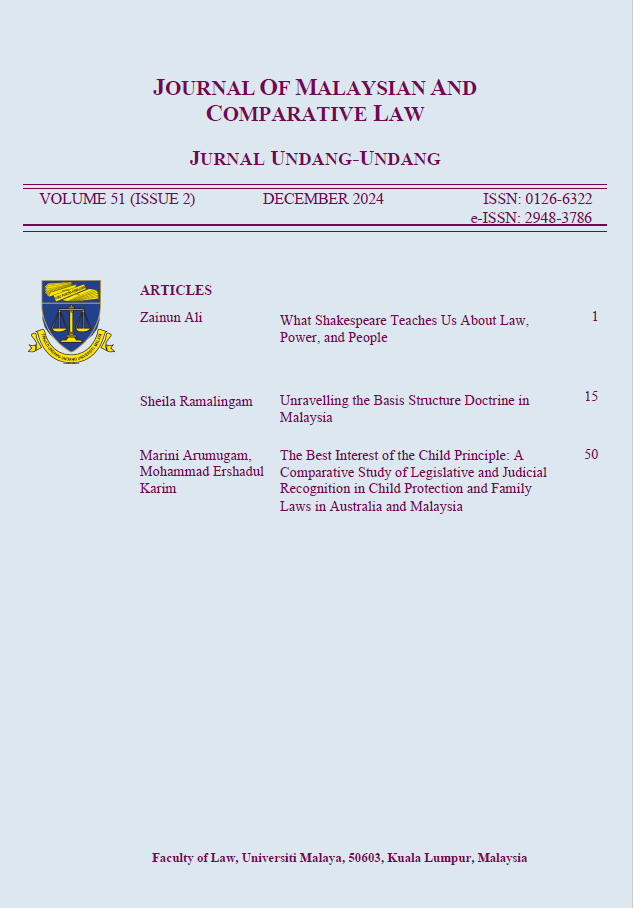
This issue of the JMCL features three articles. In the first article, “What Shakespeare Teaches Us about Law, Power, and People,” the author explores how Shakespeare’s richly layered language and the turbulent political climate of the Tudor–Stuart era reveals an enduring truth: law and power are inseparable, whether used to legitimise authority or dismantle it. Tan Sri Zainun Ali notes that every bid for control, by kings, rebels, armies, or executives, must confront the law, often by suspending or destroying it, with the legal order (including the judiciary) becoming an early target in moments of anarchy or coups. Shakespeare’s portrayal of law shifts according to the power dynamic between monarch and judiciary, reflecting a world where judges lacked true independence yet still drew legitimacy from common law and England’s ancient constitution, an echo of today’s doctrines of separation of powers and the rule of law. The author argues that Shakespeare uses his characters as mirrors, allowing us to confront our own flaws and understand universal themes of justice and power; and while his depictions of ordinary people are raw and sometimes violent, they underscore a crucial lesson: when the law serves only the powerful rather than the people, resentment breeds rebellion and disorder. Ignoring this warning, the author concludes, remains perilous for the modern legal fraternity.
The second article, “Unravelling the Basic Structure Doctrine in Malaysia”, reiterates that a nation’s constitution, its “document of destiny”, defines the structure, limits, and purposes of government, safeguards fundamental rights, and anchors the core values of its society, while remaining a living document capable of adapting to changing needs through amendments. In Malaysia, this adaptability is built into the Federal Constitution, with amendment powers vested in Parliament; yet a profound judicial debate has arisen over the basic structure doctrine, an implied limitation preventing amendments that would undermine the Constitution’s essential framework. In this article, Sheila Ramalingam, explores the meaning and scope of that basic structure within Malaysia’s constitutional order, tracing how the doctrine, though historically influenced by Indian jurisprudence, has evolved into a uniquely Malaysian concept grounded in constitutional supremacy under Article 4, and assessing how the courts have interpreted and localised it in shaping the nation’s constitutional future.
In the third paper, “The Best Interest of the Child Principle: A Comparative Study of Legislative and Judicial Recognition in Child Protection and Family Laws in Australia and Malaysia”, Marini Arumugam and Mohammad Ershadul Karim highlight that the best interest of the child principle has been a key standard in children’s law worldwide since the adoption of the the United Nations Convention on the Rights of the Child, 1989, guiding decisions about a child’s safety, development, and rights. However, in Malaysia, despite being a signatory to this Convention, 1989, this principle is still not fully built into major child protection and non-Muslim family laws, which continue to use the older and narrower “welfare of the child” test and lack clear legal guidelines. This gap is compounded by Malaysia’s plural legal system of civil, Sharia, and customary laws, resulting in inconsistent application and limited protections for children. Using doctrinal and comparative methods, and drawing from Australia’s well-established legislative model with structured guidelines and a child-centred statutory framework, this research finds that Malaysia falls short of Article 3 of the Convention, 1989 obligations and recommends comprehensive reforms to the Child Act 2001, the Law Reform (Marriage and Divorce) Act 1976, and the Guardianship of Infants Act 1961 to embed the best interest of the child as a primary consideration supported by clear, enforceable guidelines.
Associate Prof. Dr. Mohammad Ershadul Karim
NAVIGATION
Artificial Intelligence Policy
Ethics and Malpractice Statements
MEMBER OF
SUPPORTED SOCIETIES
SUPPORTED CONFERENCE
VISITORS